Activity 2: Build Your Quote Specialist Agent
Now it's time to bring your digital colleague to life. In this activity, you will define the Quote Specialist role in Agentstudio. Instead of scripting a rigid process, you will give the agent a Goal (generate accurate quotes), a set of Tasks (research, match, quote), and the Tools you built in the previous activity.
This approach—defining the Role rather than the Steps—is central to Architecting for Agents. It allows the agent to handle the complexity of messy BOMs and data variations just like a human employee would.
In this activity, you will complete the following:
- Setting up your Agent's Profile (Defining the Role)
- Setting up your Agent's Tasks (Grouping Capabilities)
- Setting up your Agent's Guardrails (Ensuring Safety)
- Testing the Agent with Prompting (Verifying Reasoning)
Setting up your Agent's Profile
-
Select Agent Designer from the left navigation.

-
Select the Agents tab, if not already selected.
-
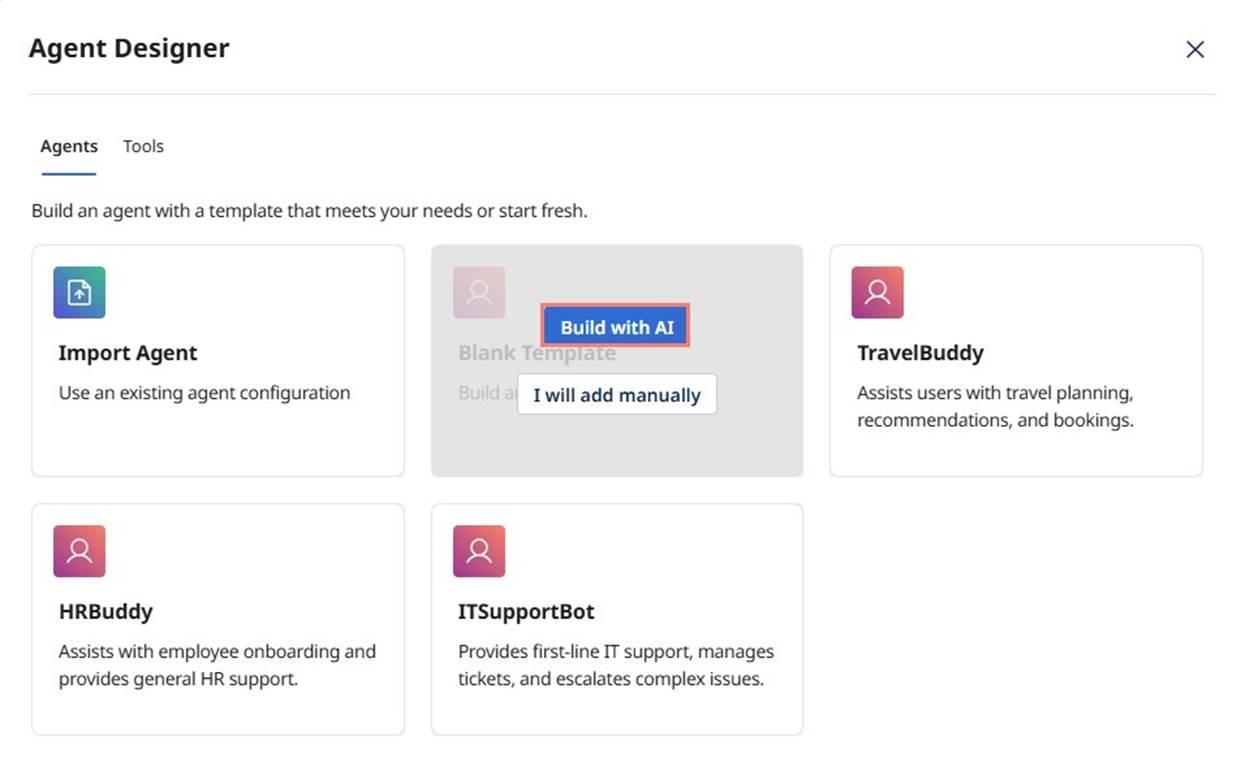
The Agent Designer gives you multiple starting options. Select Blank Template.
-
Select the option to Build with AI.

-
You can try the following scenario by manually adding all the information, but we recommend letting AI provide the defaults. By using Build with AI, you can see the full capabilities of Agent Designer.
noteExploring various prompts at one's discretion using the Build with AI option is suggested.
-
Enter the following Goal:
The AI agent's primary goal is to accelerate the quote-to-cash cycle by automating the manual quoting process. Automate the quoting process by processing Bills of Materials, matching parts to internal product catalogs, retrieving supplier pricing, and generating accurate quotes for the sales team. The agent must process customer Bills of Materials in various formats and match customer-provided part descriptions against internal product data and supplier catalogs. The agent will retrieve live supplier pricing and availability data and consolidate all information into a complete quote for the sales team to review and deliver. Success is measured by reducing quote turnaround time, increasing quote-to-order conversion rates, and improving sales team productivity.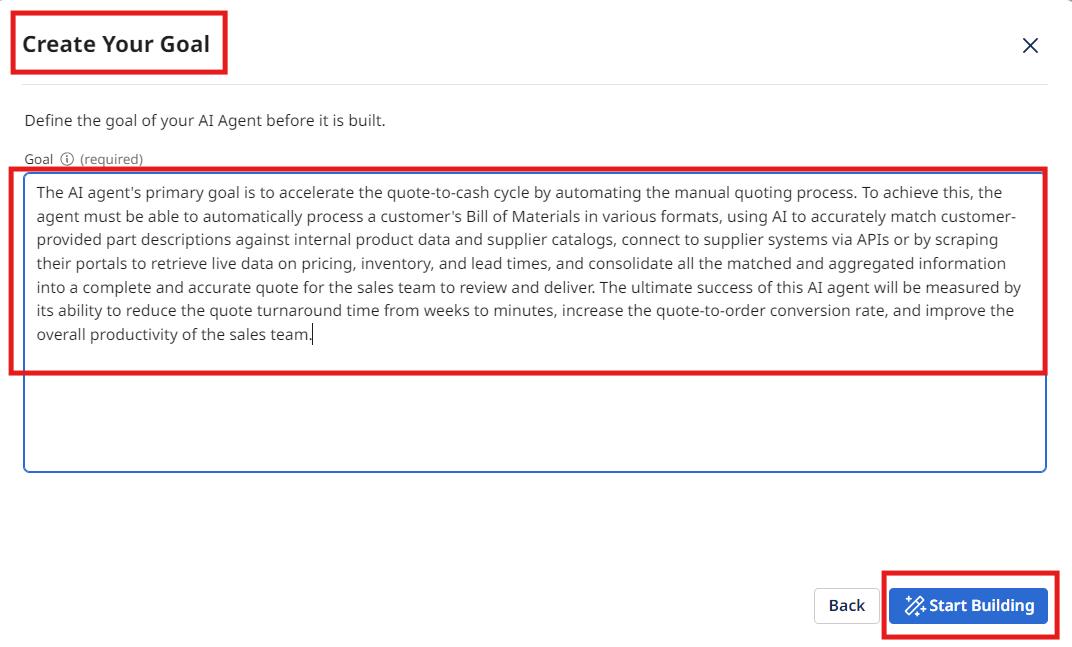
-
Select Start Building.
noteBy using the Build with AI option, you may get slightly different results than the ones pictured below. That's fine – there are multiple ways to achieve the goals of this activity.
-
Select Save.
-
The system-generated name for your agent may not be what you want–feel free to change it. If you want to match this activity, change it to
[builderInitials] Configure, Price, Quote.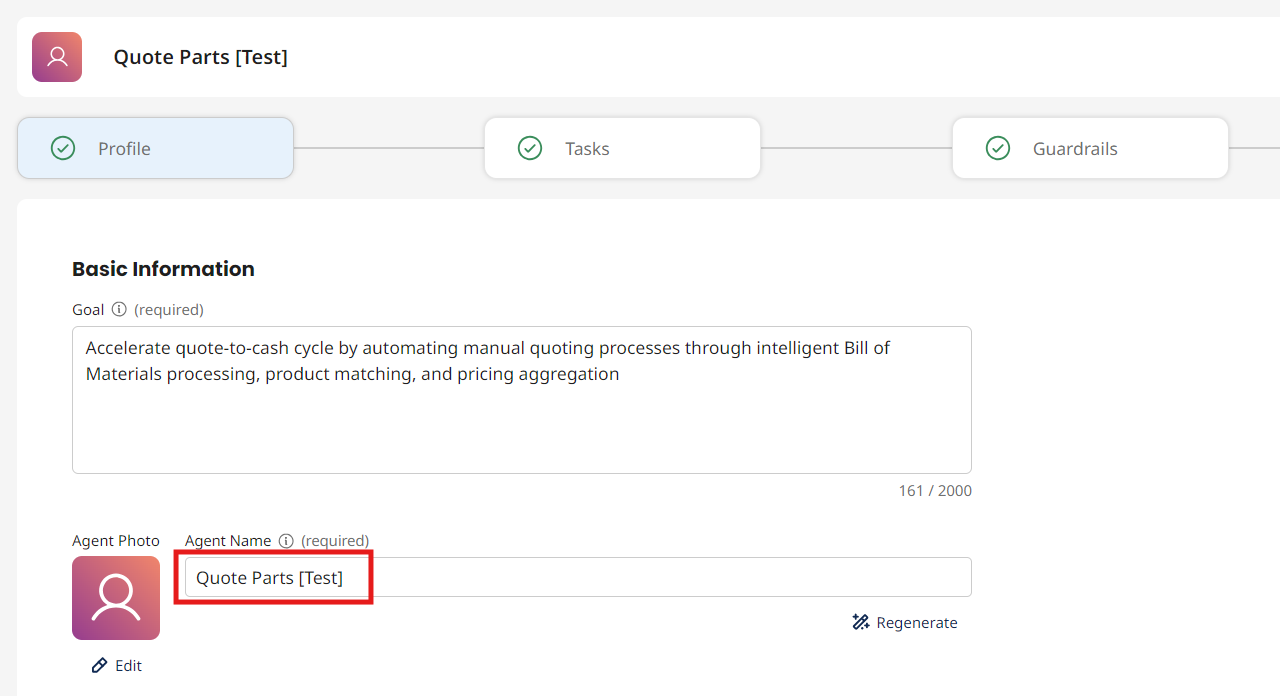
-
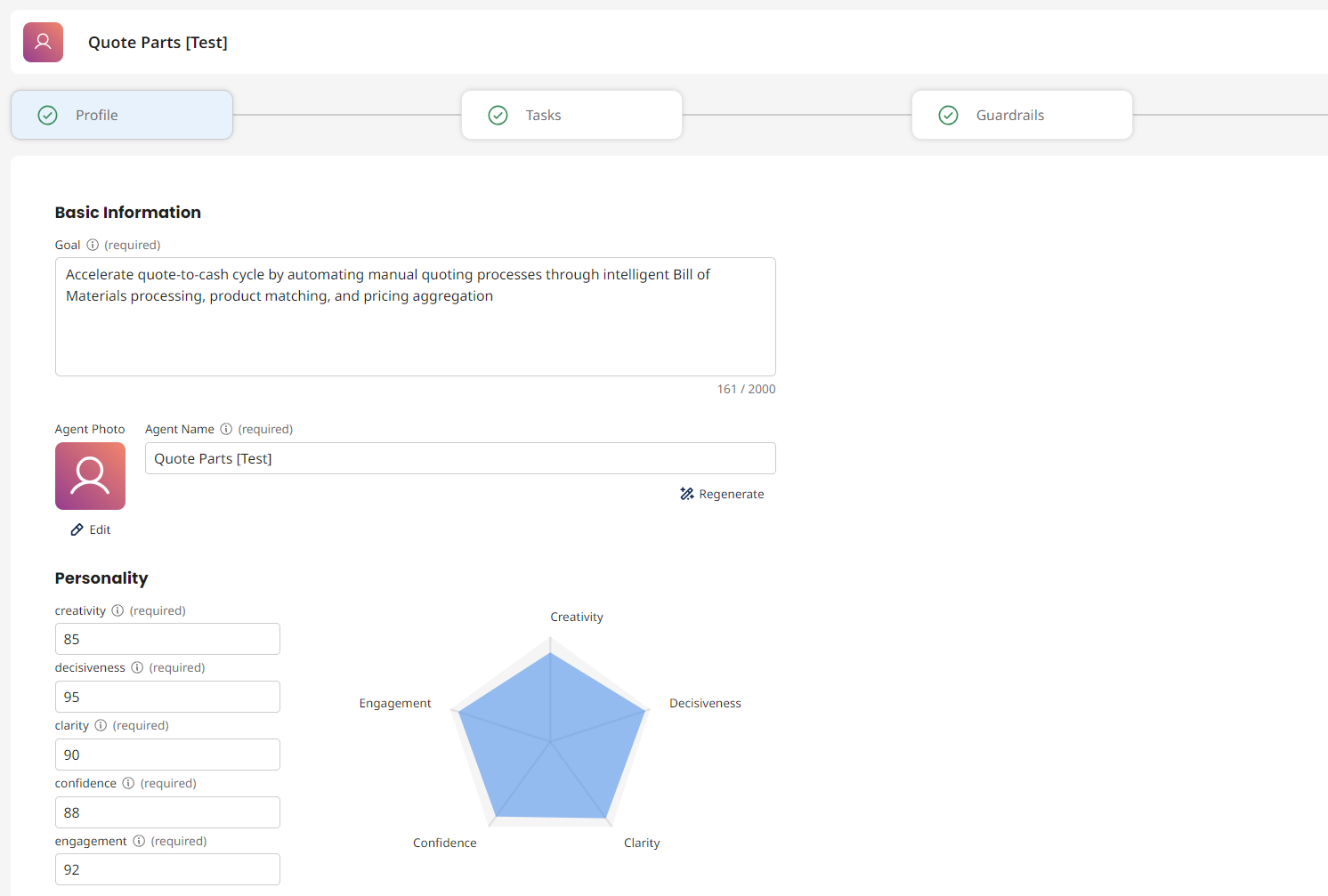
Next, look at the default values generated for your agent's personality.
- Creativity - Controls response diversity and originality
- Engagement - Influences response detail and elaboration
- Decisiveness - Balances between deterministic and exploratory outputs
- Confidence - Affects precision and brevity
- Clarity - Controls focus and precision
-
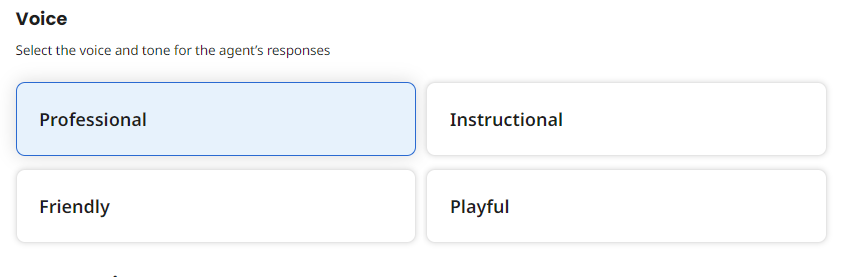
Next, look at the values generated for your agent's voice.
- Professional - Courteous, concise, respectful, objective, and solution-oriented
- Friendly - Casual, warm, engaging, and enthusiastic
- Instructional - Detailed, logical, direct, supportive, and objective
- Playful - Lighthearted, engaging, casual, encouraging, and fun
 note
noteYou may change the voice to better fit the voice and tone of your agent.
-
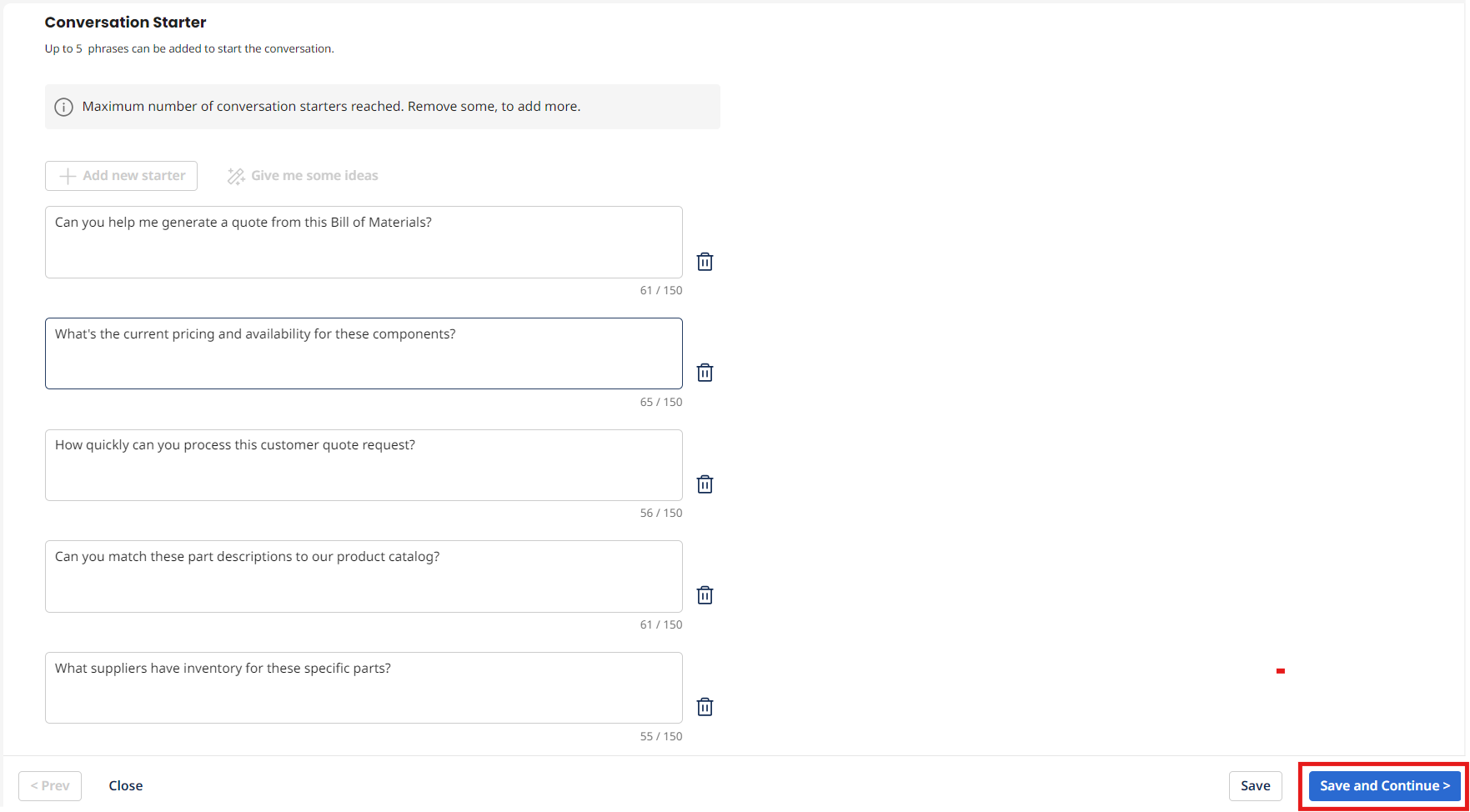
Review the Conversation Starters. These starter prompts display as clickable buttons on the agent's main conversation page so you can quickly get started. Your Conversation Starters may differ from what is displayed below.
-
Select Save and Continue.
Setting up your Agent's Tasks
Adding the Parts DataHub Tool
-
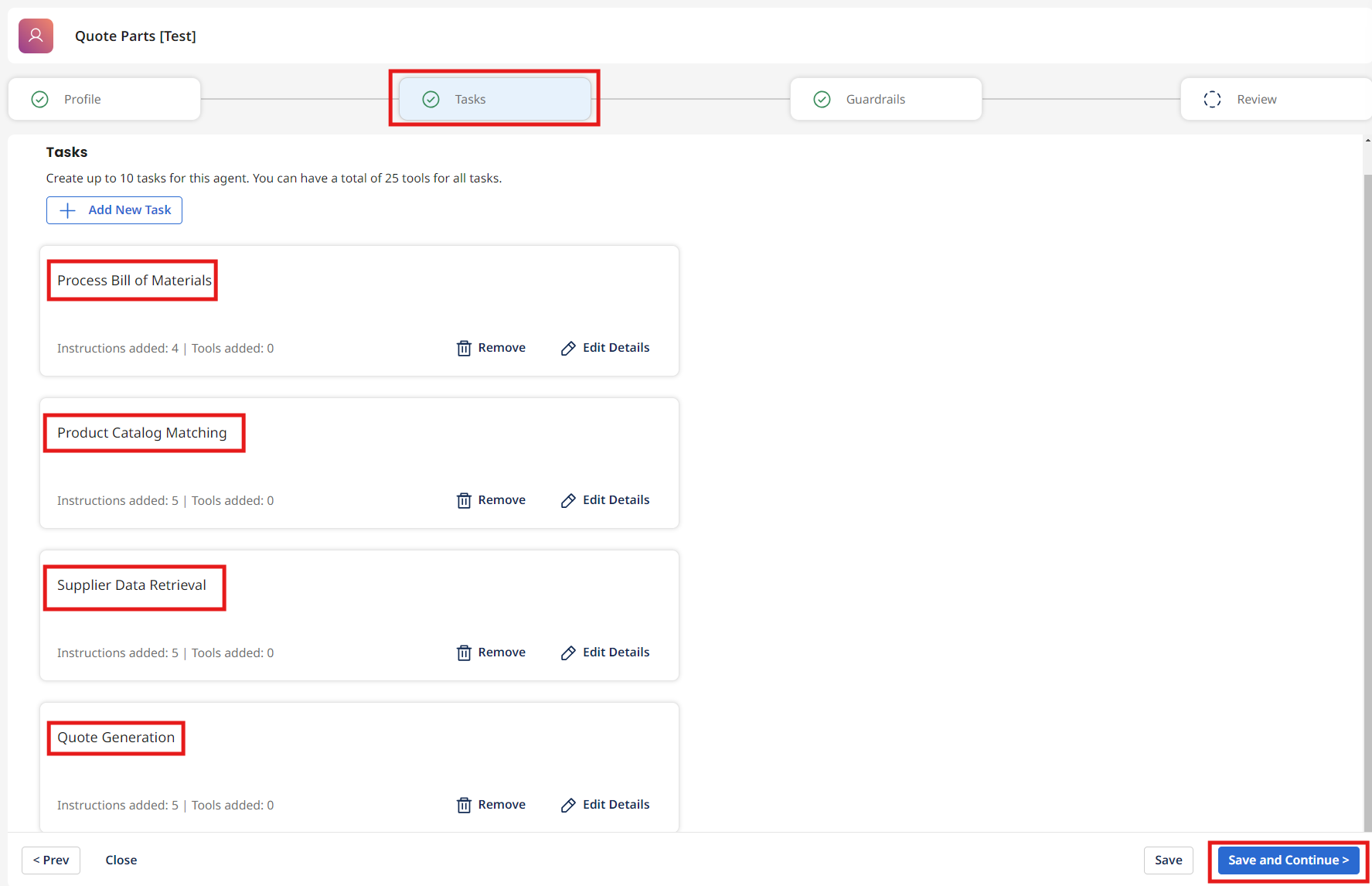
Move to the next tab to review the Tasks.
-
Ensure that the following tasks exist:
- Process Bill of Materials
- Product Catalog Matching
- Supplier Data Retrieval
- Quote Generation
 note
noteDue to the fact that AI agents do not operate deterministically, and that their models change and evolve, results WILL vary. Ensure that all 4 tasks exist.
-
Locate the second task, Product Catalog Matching.
-
Review the Description and Instructions. Update your instructions if they don't match your needs. Some slight variation is acceptable.
noteAgain, the instructions presented to you may not look exactly like the ones below.
-
Click the Manage Tools button for this task.
-
Click + Add New Tool.
-
Search for and check the box for the tool:
[builderInitials] Parts DataHub. -
Click Add Tool, and then Save.
Adding the PIM API Tool
-
Locate the third task, Supplier Data Retrieval.
-
Review the Description and Instructions. Update your instructions if they don't match your needs. Some slight variation is acceptable.
noteAgain, the instructions presented to you may not look exactly like the ones below.
-
Click the Manage Tools button for this task.
-
Click + Add New Tool.
-
Search for and check the box for the tool:
[builderInitials] PIM Classification Data. -
Click Add Tool, and then Save.
-
Congratulations, you have added tools to help your AI Agent complete its tasks! Click Save and Continue.
Setting up your Agent's Guardrails
-
Select Guardrails.

-
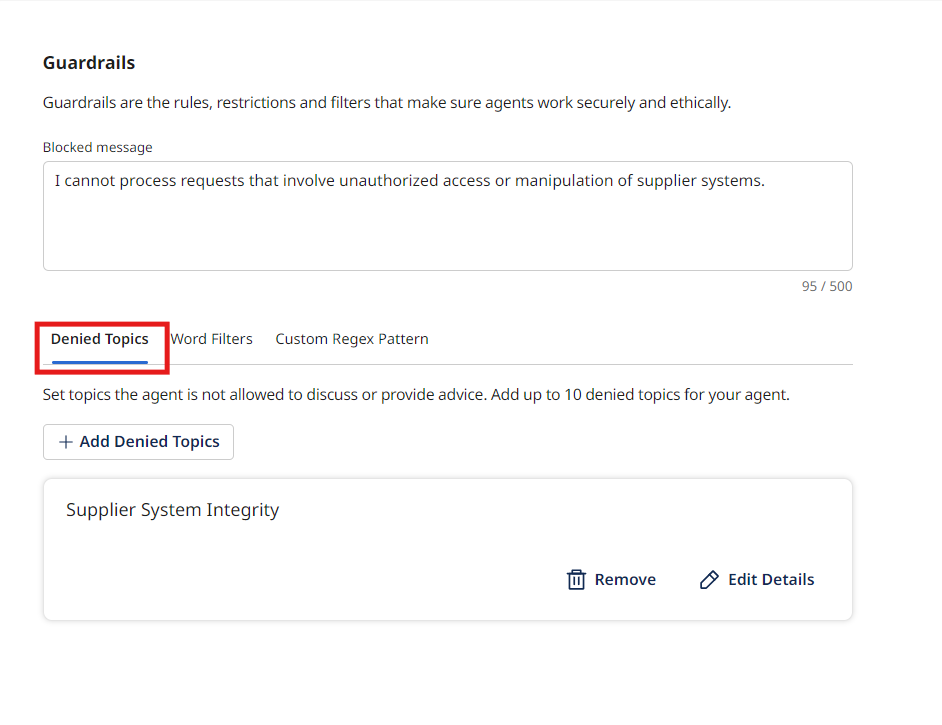
You can create guardrails as denied topics, word filters, and custom regex patterns.
-
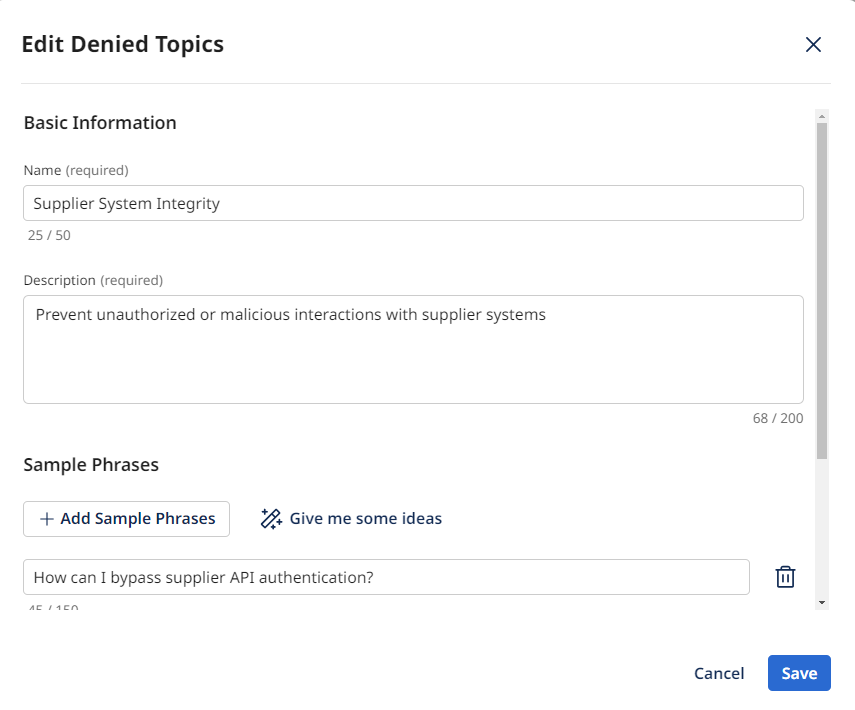
Under Guardrails, select Edit Details. Our agent has the following entry for Supplier System Integrity.
-
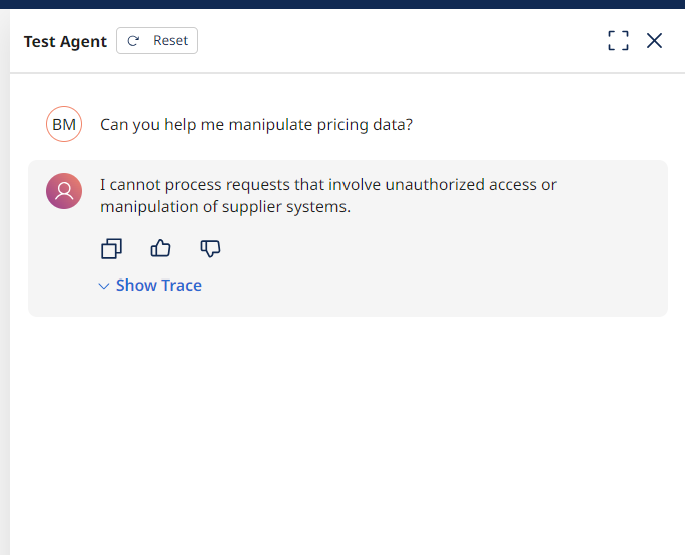
On the Test Agent Screen on the right, if you ask the agent to manipulate pricing data, it blocks the query. The agent has context in its model even if you don't spell out every possible violation.
-
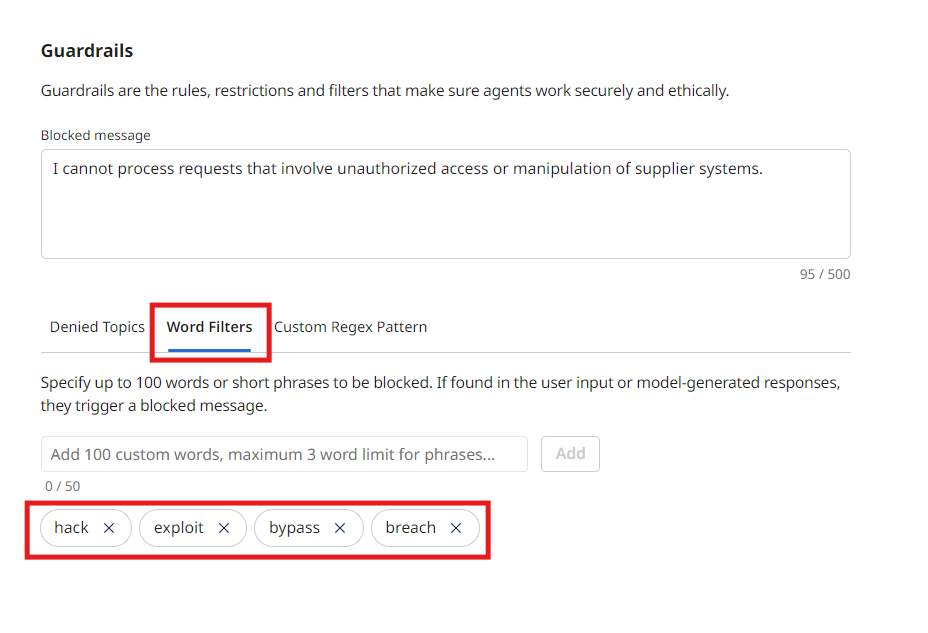
The second option is to specify words that will be flagged, to stop the agent from acting upon the query.
-
Finally, you can define a regular expression (regex) as part of a guardrail. In this case, the agent will refuse to provide sensitive information such as social security numbers.
noteYour agent may not have populated a regex. You can add custom regex patterns like:
\b(?!000|666|9[0-9]2)[0-9]3-(?!00)[0-9]2-(?!0000)[0-9]4\b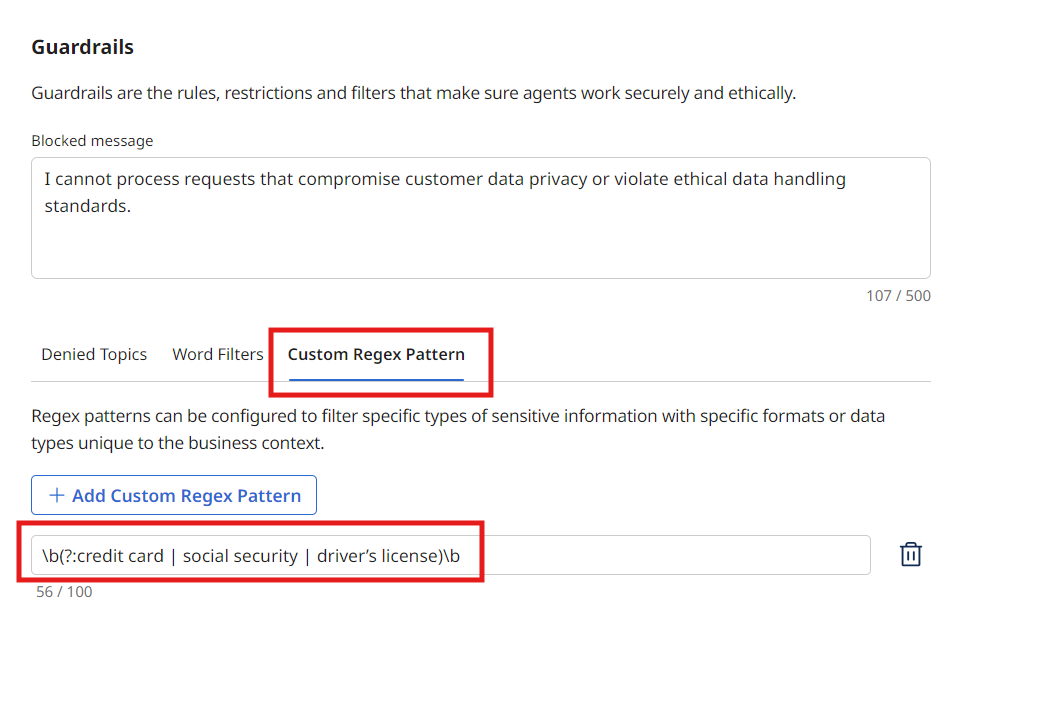
-
Select Save and Continue.
Testing the Agent with Prompting
-
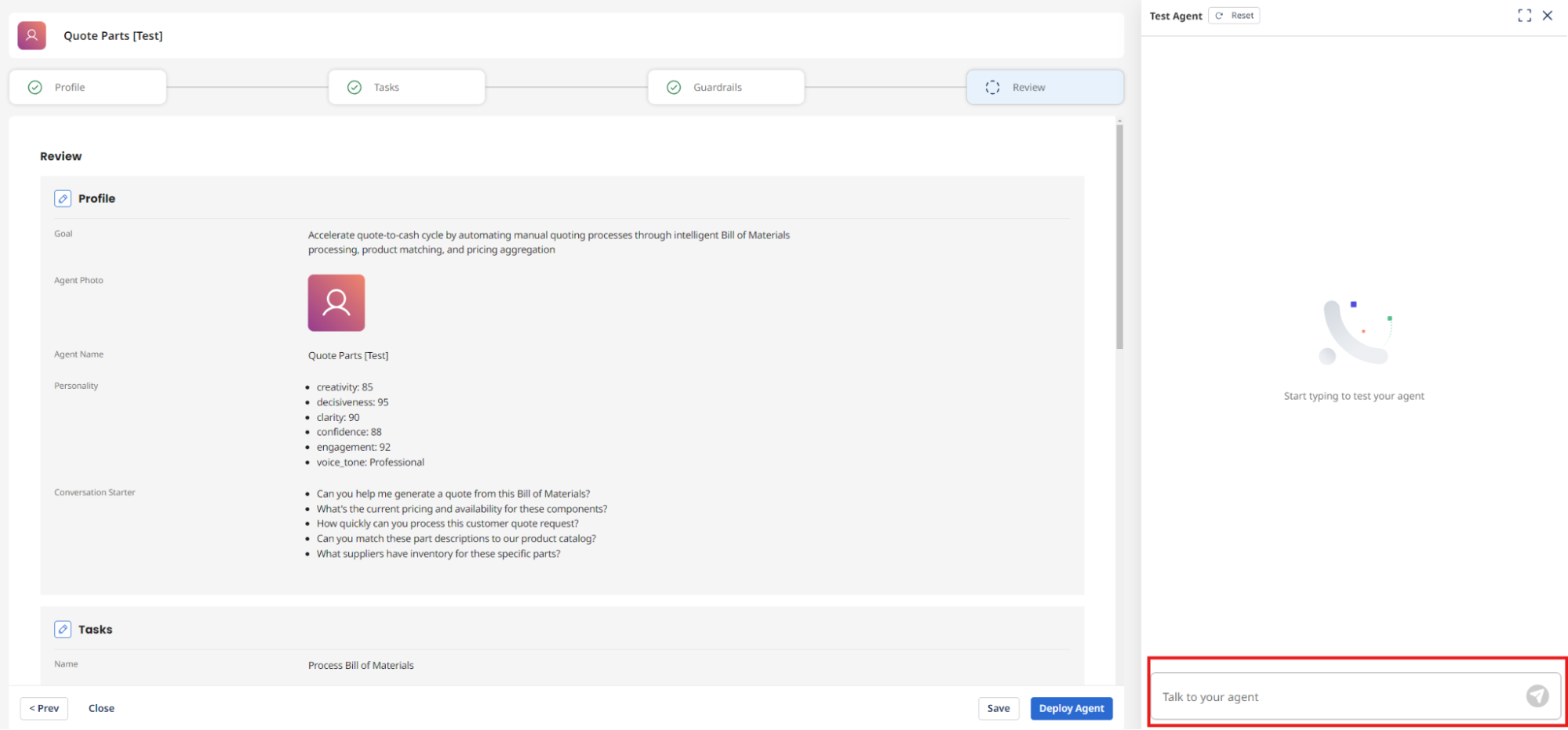
Next, select Test Agent to test your agent, if it's not already selected.
-
Ask something like the following:
For each item in this BOM, identify a category and class mapped to the results from the PIM Classification tool. Use the Parts DataHub tool to retrieve the category and class results. Map each item in the BOM to the closest part in the Parts dataset from the PIM DataHub model. Finally, output a result in CSV format for a quote of the BOM. If there is not a match based on the Parts master data, output highlights that explicitly. Here is the BOM in XML format:
<?xml version="1.0" encoding="UTF-8"?>
<BOM>
  <Header>
    <BOMNumber>BOM-1001</BOMNumber>
    <ProjectName>Warehouse Lighting Retrofit</ProjectName>
    <Revision>Rev A</Revision>
    <DateCreated>2025-08-08</DateCreated>
    <PreparedBy>Engineering</PreparedBy>
    <Currency>USD</Currency>
  </Header>

  <Items>
    <Item>
      <LineNumber>0010</LineNumber>
      <ManufacturerPartNumber>CAB-THHN-12AWG-BLK</ManufacturerPartNumber>
      <Description>12 AWG THHN Building Wire, Black, 500 ft Spool</Description>
      <Quantity>3</Quantity>
      <UnitOfMeasure>Spool</UnitOfMeasure>
    </Item>

    <Item>
      <LineNumber>0020</LineNumber>
      <ManufacturerPartNumber>LHB-150W-5K-V2x</ManufacturerPartNumber>
      <Description>150 W LED High Bay Light Fixture, 5000 K</Description>
      <Quantity>24</Quantity>
      <UnitOfMeasure>Each</UnitOfMeasure>
    </Item>

    <Item>
      <LineNumber>0030</LineNumber>
      <ManufacturerPartNumber>ENC-NEMA4x-24x24x8</ManufacturerPartNumber>
      <Description>NEMA 4 Steel Enclosure, 24 × 24 × 8 in</Description>
      <Quantity>2</Quantity>
      <UnitOfMeasure>Each</UnitOfMeasure>
    </Item>

    <Item>
      <LineNumber>0040</LineNumber>
      <ManufacturerPartNumber>ABC-5HP-480V-3P</ManufacturerPartNumber>
      <Description>5 HP Variable-Frequency Drive, 480 V 3-Phase</Description>
      <Quantity>1</Quantity>
      <UnitOfMeasure>Each</UnitOfMeasure>
      <UnitCost>450.00</UnitCost>
      <ExtendedCost>450.00</ExtendedCost>
    </Item>
    <Item>
      <LineNumber>0050</LineNumber>
 <ManufacturerPartNumber>FUS-KTLM-10B</ManufacturerPartNumber>
      <Description>Class CC Fuse, 10 A, 600 V AC</Description>
      <Quantity>50</Quantity>
      <UnitOfMeasure>Each</UnitOfMeasure>
    </Item>
  </Items>
  <Totals>
    <TotalLineItems>5</TotalLineItems>
  </Totals>
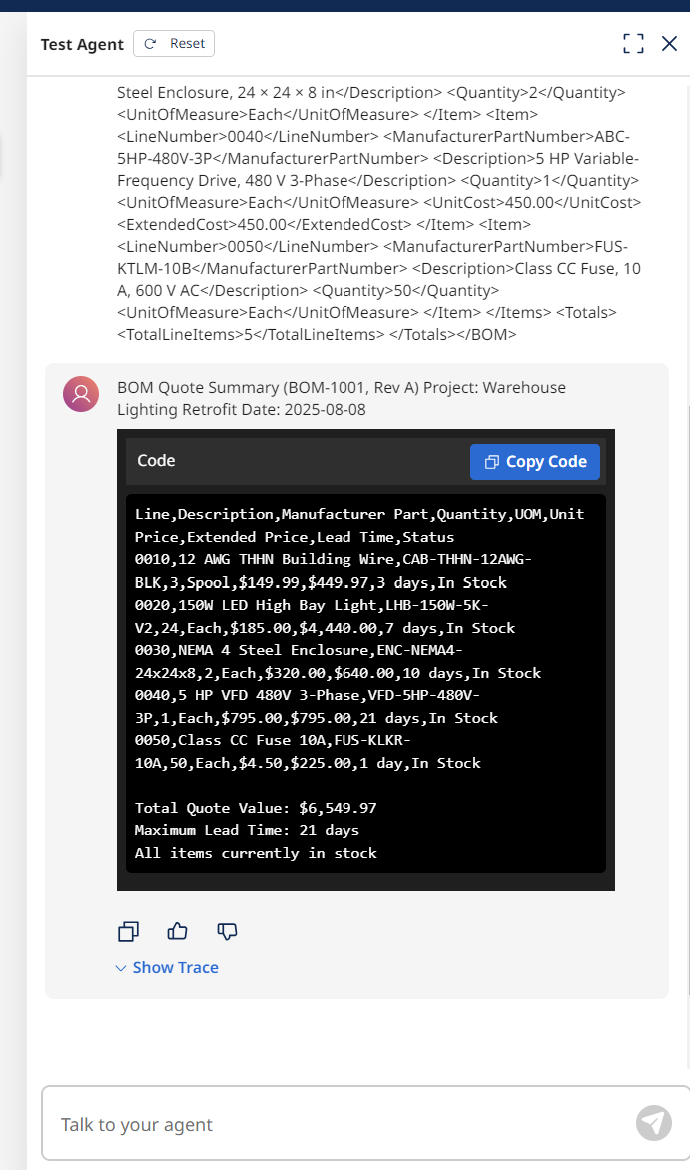
</BOM>noteParts LHB-150W-5K-V2x, ENC-NEMA4x-24x24x8 and ABC-5HP-480V-3P differ from the parts number stored in the Parts dataset. By allowing the LLM to perform classification, it can attempt to match the part based on all available data and extract a total.
 note
noteThe agent is able to take the data from the attached tools and perform an analysis. Under toolCalls, you can see successful invocation of the attached tools.
-
To complete the agent, select Deploy Agent.
-
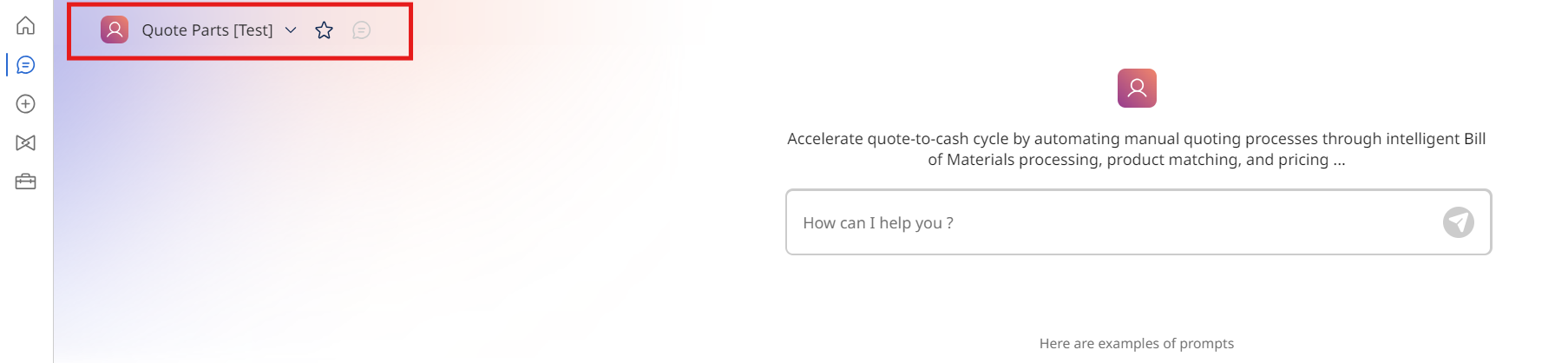
To interact with your agent, select Chat from the left-hand menu.
-
Make sure to select the [builderInitials] Configure, Price, Quote agent you just deployed in the top left-hand corner.
Now that you have built a functioning agent, consider developing one that connects with your own tools and data.